
Understanding Your Car's Maintenance Schedule
A complete introduction to manufacturer service intervals, what each milestone covers, and how to use your owner's manual to guide spending.
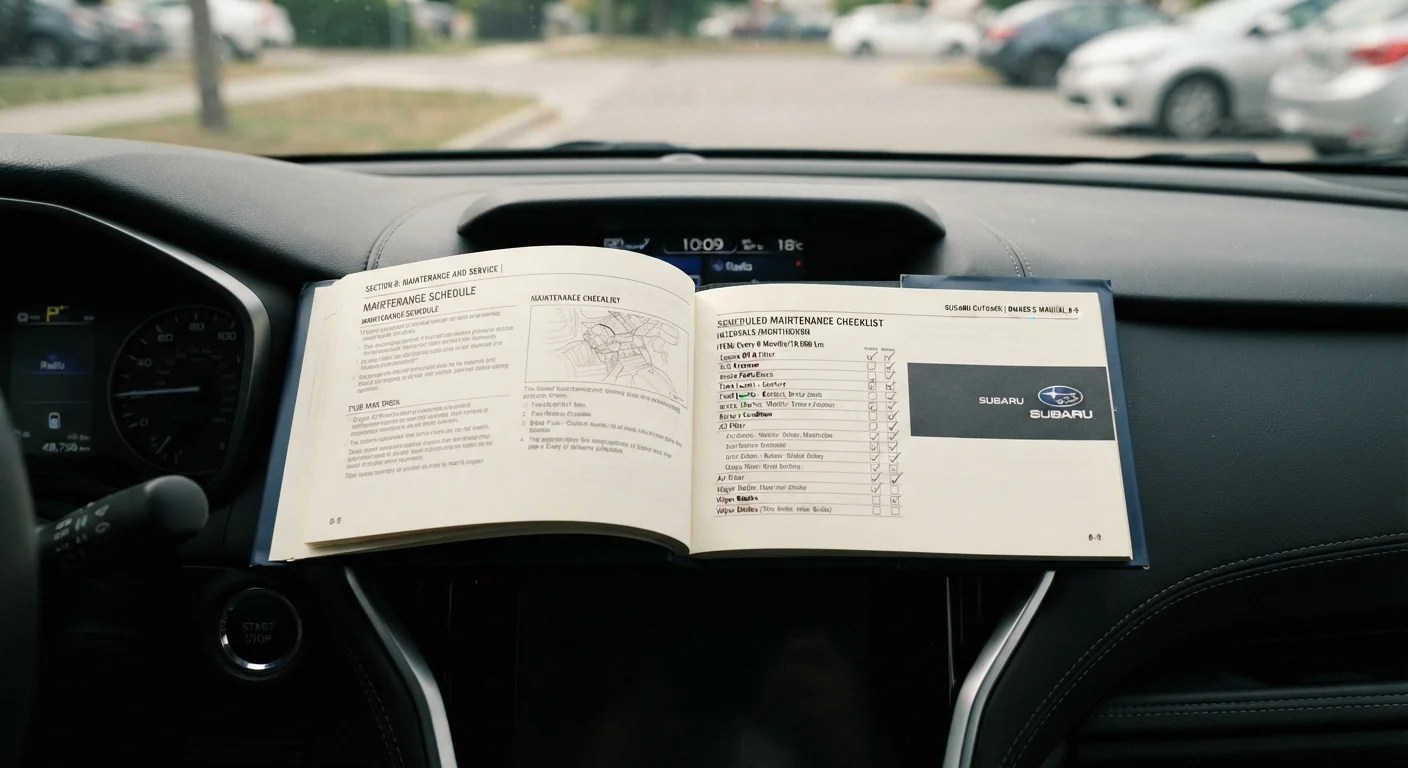
Photo: appropriateanswers.com editorial
—— In This Article
Key Takeaways
- Your car's manufacturer sets service intervals based on engineering tests, not shop revenue targets.
- The owner's manual is the authoritative source for what needs service and when.
- Many drivers qualify for longer oil change intervals than the traditional 3,000-mile rule.
- Skipping scheduled maintenance can turn small wear items into expensive repairs.
- Severe driving conditions shorten most service intervals and are more common than the name implies.
What a maintenance schedule actually is
A maintenance schedule is a list of inspections and part replacements your vehicle's manufacturer determined are needed at specific mileage or time intervals. Engineers derive these intervals from durability testing, fluid chemistry analysis, and component wear data gathered during vehicle development. The schedule is not a guess or a general industry standard; it is specific to your engine, transmission, and drivetrain.
The schedule exists primarily to prevent failure, not to generate shop visits. Following it protects your powertrain warranty and keeps small, cheap wear items from becoming expensive component failures. As noted in car ownership cost planning, maintenance is one of the recurring expenses families most often underestimate when budgeting for a vehicle.
Service interval
The mileage or time period between scheduled maintenance tasks, set by the vehicle's manufacturer based on engineering and testing data.
Owner's manual
The official document provided by the manufacturer that contains operating instructions, safety information, and the maintenance schedule for your specific vehicle.
Oil life monitoring system
A computer system in many modern vehicles that tracks engine conditions and calculates when the oil actually needs to be changed, rather than counting miles.
Severe driving conditions
A manufacturer-defined category covering driving patterns that accelerate component wear, such as frequent short trips, towing, or operation in extreme temperatures.
Timing belt
A rubber belt inside the engine that synchronizes the movement of internal components. If it breaks while driving, it can cause serious and often irreparable engine damage.
Magnuson-Moss Warranty Act
A U.S. federal law that generally prevents manufacturers from requiring you to use their dealership for routine maintenance as a condition of keeping your vehicle warranty.
Key service milestones and what they cover
Most manufacturer schedules organize service into repeating mileage bands. A typical light-duty passenger car schedule looks roughly like this:
- Every 5,000 to 10,000 miles: oil and filter change, tire rotation, visual inspection of lights and fluids.
- Every 15,000 to 30,000 miles: air filter inspection or replacement, cabin air filter, brake inspection, battery test.
- Every 30,000 to 60,000 miles: spark plug replacement (on many engines), coolant flush, transmission fluid check or change, drive belt inspection.
- Every 60,000 to 100,000 miles: timing belt replacement (if your engine has one), fuel filter on some vehicles, power steering fluid flush on older systems.
Intervals vary by make, model, and engine type. Diesel engines, turbocharged engines, and hybrid powertrains each have their own schedules. Never assume your intervals match a neighbor's car just because the vehicles look similar.
How to read your owner's manual
The owner's manual is usually in the glove box. If it is missing, the manufacturer's website or a service like the National Highway Traffic Safety Administration's (NHTSA) vehicle lookup can sometimes help you locate a digital copy. Look for a section titled 'Scheduled Maintenance,' 'Maintenance Intervals,' or 'Service Guide.'
Most manuals present two schedules side by side: one for normal driving and one for severe driving. Each row in the table names a service item, and the columns show the mileage or month intervals at which that item is due. Time intervals matter too; a car driven only 3,000 miles per year should still change its oil annually because oil degrades from moisture and combustion byproducts even when the vehicle sits.
Many late-model vehicles include an oil life monitoring system that calculates change intervals based on actual engine data rather than a fixed mileage counter. When this system triggers a warning, follow it. When it does not, follow the maximum time interval listed in the manual.
Normal vs. severe driving conditions
The word 'severe' sounds extreme, but the definition covers a wide range of everyday situations. Manufacturers typically classify driving as severe if it regularly involves any of the following: trips under five miles, extended idling, towing or carrying heavy loads, dusty or unpaved roads, or operation in temperatures consistently below 10 degrees Fahrenheit or above 90 degrees Fahrenheit.
City commuters who take short, stop-and-go trips often fall into the severe category. Short trips prevent the engine from fully warming up, which leaves moisture in the oil and accelerates wear. If your commute fits this pattern, the severe schedule is the right one to follow, even if the name feels out of place for routine errands.
Many shops default to the severe schedule for all customers, which is not always wrong, but it does generate more frequent service visits. Knowing which category your driving actually fits lets you have an informed conversation with a service advisor rather than simply accepting whatever the reminder system suggests. This connects directly to common maintenance myths that cost families money.
Using the schedule to control costs
The schedule works as a cost control tool when you treat it as a planning document rather than a reactive checklist. Knowing that your vehicle needs a coolant flush at 60,000 miles, for example, lets you budget for it in advance instead of facing an unexpected bill.
Grouping services that fall near the same mileage point into one shop visit reduces labor costs, since the technician is already under the car. Ask the service advisor which upcoming items can be done together before authorizing individual repairs one at a time.
Document every service in writing, whether you use a shop or do the work yourself. A record of completed maintenance supports any warranty claim and increases resale value; buyers and dealers can see that the car was cared for on schedule. The same principle applies across household assets: deferred maintenance tends to compound costs regardless of whether the asset is a car or a house.
Finally, the schedule tells you what is not due. If a shop recommends a service that is not listed in your manual or is not yet at its mileage threshold, you have a basis to ask why before spending money on it.
Group services to cut labor costs
When two or more scheduled services fall within a few thousand miles of each other, ask the shop to complete them in one visit. Labor is often the largest line item on a repair order, and combining services avoids paying multiple trip charges or diagnostic fees for the same appointment.
Frequently Asked Questions

Affordable Auto Care Editorial Team
Affordable Auto Care Editorial Team is the collective byline for our editorial team and contributor network. Articles published under this byline or an editorial pen name are researched, written, and reviewed according to our editorial standards for clarity, consistency, and independence before publication.
View author profile