
Why Skipping the Cabin Air Filter Costs You More Than the Filter Itself
A clogged cabin air filter strains your HVAC system and degrades air quality. Learn what it does, how often to change it, and what to expect.
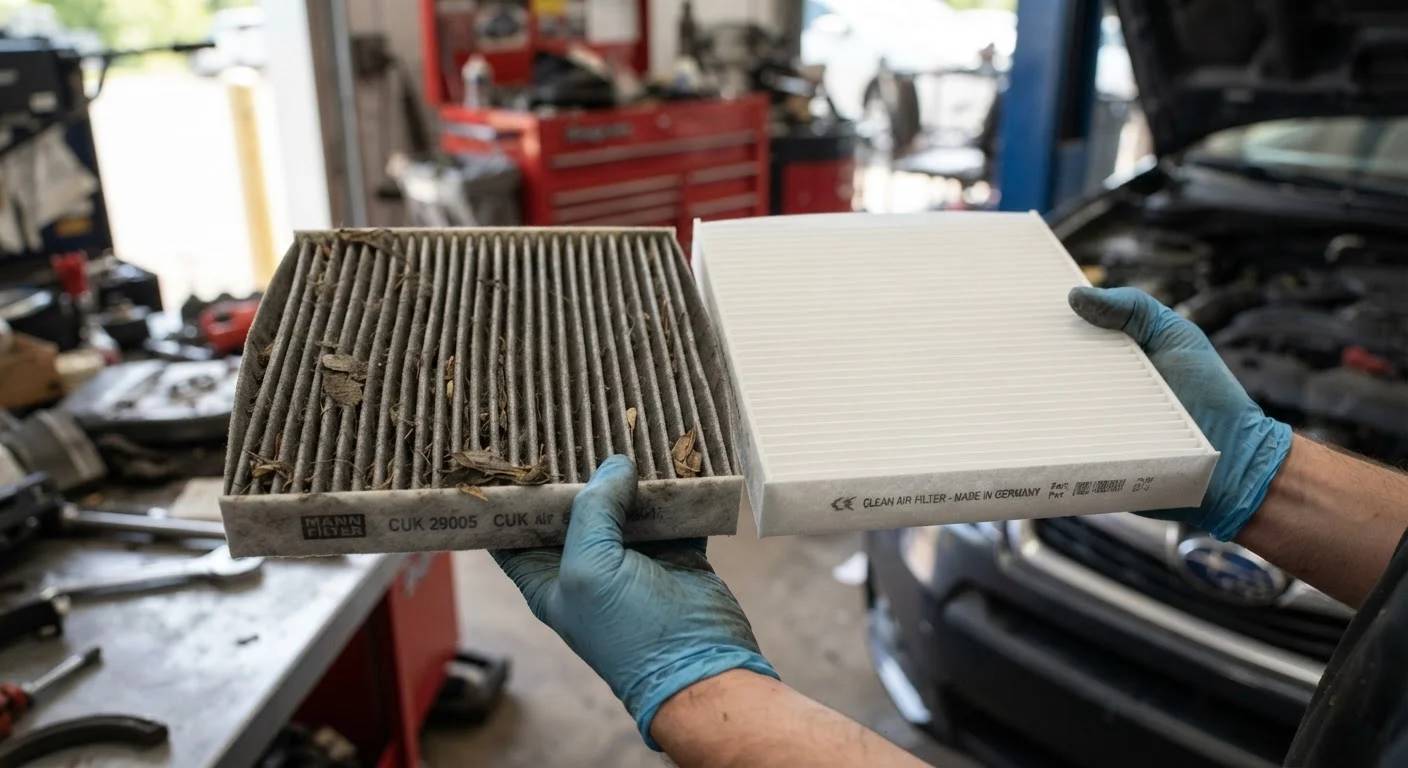
Photo: appropriateanswers.com editorial
—— In This Article
Key Takeaways
- A clogged cabin air filter forces your HVAC blower motor to work harder, shortening its lifespan.
- Most manufacturers recommend replacing the cabin air filter every 15,000 to 25,000 miles.
- Filters typically cost between $15 and $40, while a blower motor replacement can run several hundred dollars.
- Many cabin air filters are accessible without tools and can be swapped in under 15 minutes.
- Poor filtration circulates dust, pollen, and mold spores throughout the passenger cabin.
What the cabin air filter actually does
The cabin air filter sits in the path of outside air before it enters the passenger compartment through your heating and cooling system. It captures dust, pollen, soot, and other airborne particles so they do not circulate inside the car. On vehicles with activated charcoal filters, it also reduces exhaust odors pulled in from traffic.
Because the filter is hidden, usually tucked behind the glove box or under the dashboard, it does not get the visual attention that, say, a low tire or a cracked wiper blade gets. That invisibility is exactly why it tends to get skipped.
Assuming the cabin air filter never needs changing because the car seems to run fine.
Why it happens: Cabin air filter degradation is gradual, so drivers rarely notice a single dramatic change that signals it is time to act.
Confusing the cabin air filter with the engine air filter and skipping one because the other was recently changed.
Why it happens: Both are called air filters, and service reminders sometimes group them together without distinguishing which is which.
Relying solely on a shop's inspection without knowing the filter's actual age or mileage.
Why it happens: Service advisors sometimes recommend replacement based on appearance alone, which can either flag a filter too early or miss one that is blocked but looks gray rather than black.
Paying full shop labor rates for a filter swap that most drivers can do themselves.
Why it happens: Many drivers do not know the filter location, assume the job requires mechanical skill, or simply forget it is an option.
Ignoring persistent odors or weak airflow because they seem like minor annoyances.
Why it happens: Drivers acclimate to gradual changes in airflow and smell, so symptoms worsen without triggering concern.
What happens when you leave a clogged filter in place
A blocked filter restricts airflow to the blower motor, the component that pushes air through your vents. The motor has to work harder to move the same amount of air, which generates more heat and draws more current. Over time, that strain wears the motor down. Replacing a blower motor costs far more than a handful of filter replacements over the same period.
Blower motor damage is an expensive consequence
A severely restricted cabin air filter makes the blower motor strain continuously against reduced airflow. Over time, this can burn out the motor. Blower motor replacement typically costs $300 to $600 at a shop, far more than the cost of regular filter changes.
Beyond the mechanical cost, a clogged filter delivers noticeably less airflow, which means your air conditioning takes longer to cool the cabin in summer and your defroster struggles to clear the windshield in winter. Both are comfort problems that can become safety problems.
Just as deferred maintenance at home tends to turn small issues into expensive repairs (see our look at the real costs of skipping routine maintenance), skipping this simple filter swap sets up a more costly repair later.
How to stay ahead of the problem
Mold can grow inside a neglected filter
Cabin air filters trap moisture along with particulates. In humid climates, a filter left in place for two or more years can develop mold growth. That mold then circulates through the vents every time you run the fan. If you notice a musty odor when the HVAC runs, the filter is the first thing to inspect.
The most practical step is to find your replacement interval in your owner's manual and write it down alongside your oil change schedule. If you drive in heavy traffic, near construction, or on unpaved roads frequently, lean toward the shorter end of the recommended range.
Before paying a shop's labor rate for a filter swap, look up the procedure for your specific vehicle. Many models require no tools at all. A filter and ten minutes of your time is all it takes on a good number of popular vehicles. If your model genuinely requires dashboard disassembly, then shop labor is reasonable. Otherwise, this is one of the more accessible DIY maintenance tasks available to any driver.
Keep a small notebook or a note in your phone with the date and odometer reading each time you replace the filter. That record costs nothing and removes all guesswork the next time a service advisor brings it up.

Affordable Auto Care Editorial Team
Affordable Auto Care Editorial Team is the collective byline for our editorial team and contributor network. Articles published under this byline or an editorial pen name are researched, written, and reviewed according to our editorial standards for clarity, consistency, and independence before publication.
View author profile